Hi folks! While I am on vacation, here’s some homework: this has most of the moves we have done in the past few weeks if you would like to practice.
Putting the pieces together
I have been learning Japanese, and the process made me think about how complicated learning tango can be. Tango is a language, and being able to communicate effectively takes time and effort.
Learning a language
I enjoy learning languages. I know that it is possible to get around in a foreign language and country while making mistakes. If you can communicate, you can get by. On the other hand, I have made colossal errors in terms of miscommunication because of lack of fluency. Some have been funny, but others were deeply embarrassing or distressing.
I have studied eight foreign languages, and (except for Latin) used them living abroad, researching, and just traveling. Three have required unfamiliar writing systems. Japanese is the only one where I have had to learn both a syllabary (two of them!) and pictograms. I look back with affection on the other languages, where I only had to learn to write one way!
As a former English teacher, I can identify parts of speech, memorize verb forms, learn word order, and figure out the gaps in my grammar to build my skills. However, trying to memorize pictograms has brought up a new issue: I memorize the shape and attach the ENGLISH translation to it. I have absolutely no idea what the Japanese sounds are that go with that picture. One more layer of complexity!
Tango as a language
Tango strikes me as a complex language where you must juggle several elements at the same time while achieving adequate fluency quickly. After all, there is not much room for mistakes as we dance close together. In addition, there are many elements in an improvised dance: navigation, what your partner is doing, what they are trying to communicate in their own dance, and the music. Because I have “spoken” tango for thirty years, I can dig into all the layers and combine them with little effort, but I also try to improve my skills as I go along.
To compare it to Japanese, you have steps to learn. Each kind of step has a name, like a syllabary has a sound per character. These steps can be put into “words” in different orders. For example, you can walk to the cross to begin a sequence of steps, or you can do a long combination and finish by walking to the cross. You can reverse moves.
The “grammar” of tango can be complicated by the fact that it is improvisatory. Steps may make more sense after specific other movements, but in theory, they can fall anywhere in a sequence. You can’t look for the verb and work the pattern out from there. This may be why dancers execute the same combinations repeatedly: they have learned “sentences” that mostly work and avoid expanding their language because they might make mistakes.
And then there is the music. To me, this is the pictogram part of the language, offered in an auditory rather than visual form, but already complete, established, and waiting for you to recognize and know what lies within that entity. You can “know” the music without being able to connect it to the other parts of the language equation. To connect it takes time and effort.
Do you speak pidgin tango?
Then there is the partner. You speak your own tango dialect, and your partner speaks another dialect (theirs). You can’t speak exactly the same language because you have two brains, two bodies, and diverse ways to react to music. How do you communicate and work together?
I like to think of this as pidgin tango. You have landed from another trading island and need to connect and dance successfully. Both of you need to be willing to explore unknown “words” and “grammar” and cobble out a mutual understanding of the music and the space available to you. If that happens, both of you gain from the interaction.
Do you tend to just yell louder like the quintessential American tourist nightmare? Or do you slow down, enunciate, and listen carefully? Which works better? :-)
Good luck with your language acquisition, uh, tango!
Try yoga to improve your tango!
Are you balance challenged in tango? Does your lead need more stability? Would you like to have more elegant adornos? Do you want to have a leg that’s more free to do boleos, sacadas, and other “loose leg” moves? Would more flexibility help your lead or follow?
Yoga can benefit your tango body!
If you are hyperflexible person like me, yoga can help you identify where you need to work your muscles to create stability for better balance and strength. If you are less flexible, yoga can help balance and strength AND train your body to be more flexible.
Yoga does not require crazy stances and fancy workout gear. It is easier to learn than tango. Yoga helps you learn about your body and how it needs to move, and you can apply that to your tango for a better dance. Why not give yoga a try right now?
My group yoga classes are currently in-person only. I do teach online yoga for individuals if you are interested in that alternative.
Forms of yoga
Mat-based yoga
Traditional yoga is done on a mat, with a fair amount of getting down to the mat and getting back up. I use props in my mat yoga to help people achieve safe, correct poses that help their bodies. Props aren’t cheating: they facilitate doing good yoga.
There are many forms of mat yoga. I teach hatha style classes with some flow (slower than power yoga) where you can focus on each pose and find your body, so that you work carefully and healthily. I modify poses for people who need to build up to a pose; there are always choices you can make for ALL poses to tailor them to what you need.
My mat-based class members always welcome anyone new to class! We hold class at 12:30 on Wednesdays and Fridays at my home studio. You are welcome to come a bit early to set up your gear (I have gear, but you are welcome to please bring your own mat if you have one). Come try it! You can sign up here. Please do not drop in without signing up.
Chair-based yoga
If you are new to yoga, you might consider trying chair yoga first. It helps you learn yoga basics in a small group setting and build up to mat yoga if that is what you would like to do.
Chair yoga does NOT mean you sit in a chair the entire time (except for classes aimed at populations who cannot get out of a chair). I teach chair yoga to work on balance and flexibility that does not require spending time getting to and from the floor. Poses are done seated or standing, and each person chooses which modification works best for them, with input from the teacher.
I build my chair yoga class based on who is attending. Do you have a bad knee? A torn rotator cuff? Arthritis? A body that is just not doing what you would like it to do?
My chair-based/beginner yoga class happens on Fridays at 11:15 for one hour. You can sign up here! We are a small class now, and all tango dancers!! You are free to come at 11 am to get ready, ask questions, and set up your gear (I have all the gear, believe me!). Please do not drop in without signing up.
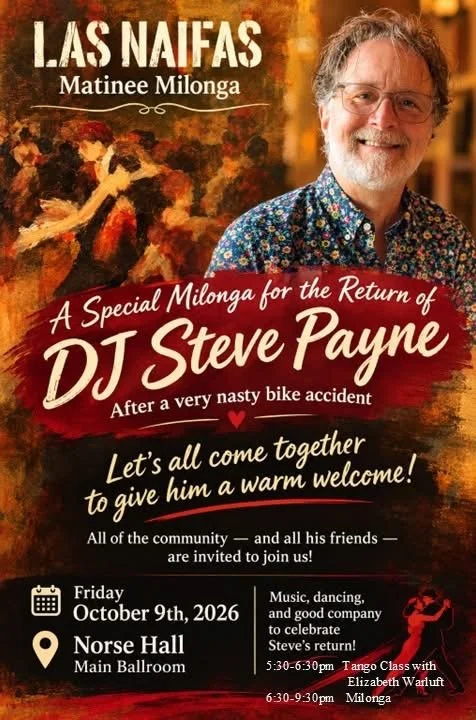
Las Naifas is on April 17th, NOT this Friday!
This is just a quick reminder that we had to move Las Naifas to next week, as Norse Hall had a conflict for our regular second Friday time. I hope you will come out and dance next week!
5:30 lesson with yours truly
6:30-9:30 dancing
Norse Hall: 111 NE 11th Ave, Portland, OR 97232
$15 for dance (lesson is free with the dance)
See you soon!
Struggling with tango confidence?
I recently came across advice for treating yourself with compassion while changing how you eat and exercise, and thought, “Wow! I have heard these feelings expressed by frustrated tanguera/os!” The main issue is learning to treat YOURSELF with gentleness, as you cannot always count on kindness from dance partners, people at practicas or from your reaction to your video camera. Here are several of the redirections:
I’m bad at this —> I’m new, not bad. Learning takes time.
I always mess this up —> I’m allowed to be imperfect. Being kind to myself helps me keep going.
I’m lazy —> I might be tired, overwhelmed, or stressed. How can I make action easier today?
I have no willpower —> This needs strategy, not more willpower. How can I design this to be easier?
I should be further along by now —> There’s no deadline for this learning process; I’m growing at my own pace.
Everyone else is doing better than I am —> Others’ progress doesn’t erase mine. My journey is mine.
I hope one of these makes your tango week a little easier! They are helping me both with losing weight and getting into the habit of working out more effectively.
No class April 2nd! Field trip!
Hi folks! Just a reminder that there is no group class Thursday evening, April 2nd. I would like us all to go dance at the fundraiser for Blanchet House at Norse Hall, 111 NE 11th Ave, Portland, OR 97232. It’s a worthy cause, and we as a community need to support each other’s efforts! Here’s some information about Blanchet House. The minimum donation is $20. There is a 7:30 lesson with Adam and Marina, then dancing at 8:30 until midnight. I won’t last that long, but I should be there around 8:30. See you there?
Find your tango feet!
For me, tango begins at the feet. I need them for my technique and balance, but also for my musicality: how I take every step of the dance. What are you doing to improve your foot awareness? How are you building your balance? Where does your focus need to be to create your most musical, vibrant, present dance? Let’s start with your feet.
Wake up your feet
Sometimes your brain needs help to find your feet. The most extreme example I have encountered was when I asked a student what foot their weight was on, and that person had to look down to tell me. Most of the time, you have weight on both feet as you transfer your weight while walking and tuning into that process helps you with balance and musicality. Here are exercises to help you find your feet:
Massage/roll your feet
Carry massage balls with your dance shoes and roll the soles of your feet before donning dance shoes. This is a fantastic way to wake up your soles. Experiment: some people like soft massage balls or bumpy, hard ones; or a roller instead of a ball will help if your balance is shaky. Pro tip: hold onto something while you roll your feet at first.
Stretch the tops of your feet and under your toes
I use both stretches in my yoga practice and suggest you implement them for healthier tango feet.
If you can’t sit on the tops of your feet, it’s ok to lean forward and/or support yourself on your hands until the tops of your feet are stretchy enough to sit back on them. Here’s a short video to help you.
For toes under, I have short toes, so I have to adjust them manually before sitting back. It’s easier with longer toes, but many of us do not stretch here, and it may be extremely uncomfortable at first. Take your time and ease into sitting on your heels. I promise this gets easier as you practice! Here is a short video to help you.
More foot stretches and strengtheners
Heidi Weiss and I made two videos about foot health and tango. You can follow along here and here. I have posted this before but thought you would like to find everything in one place!
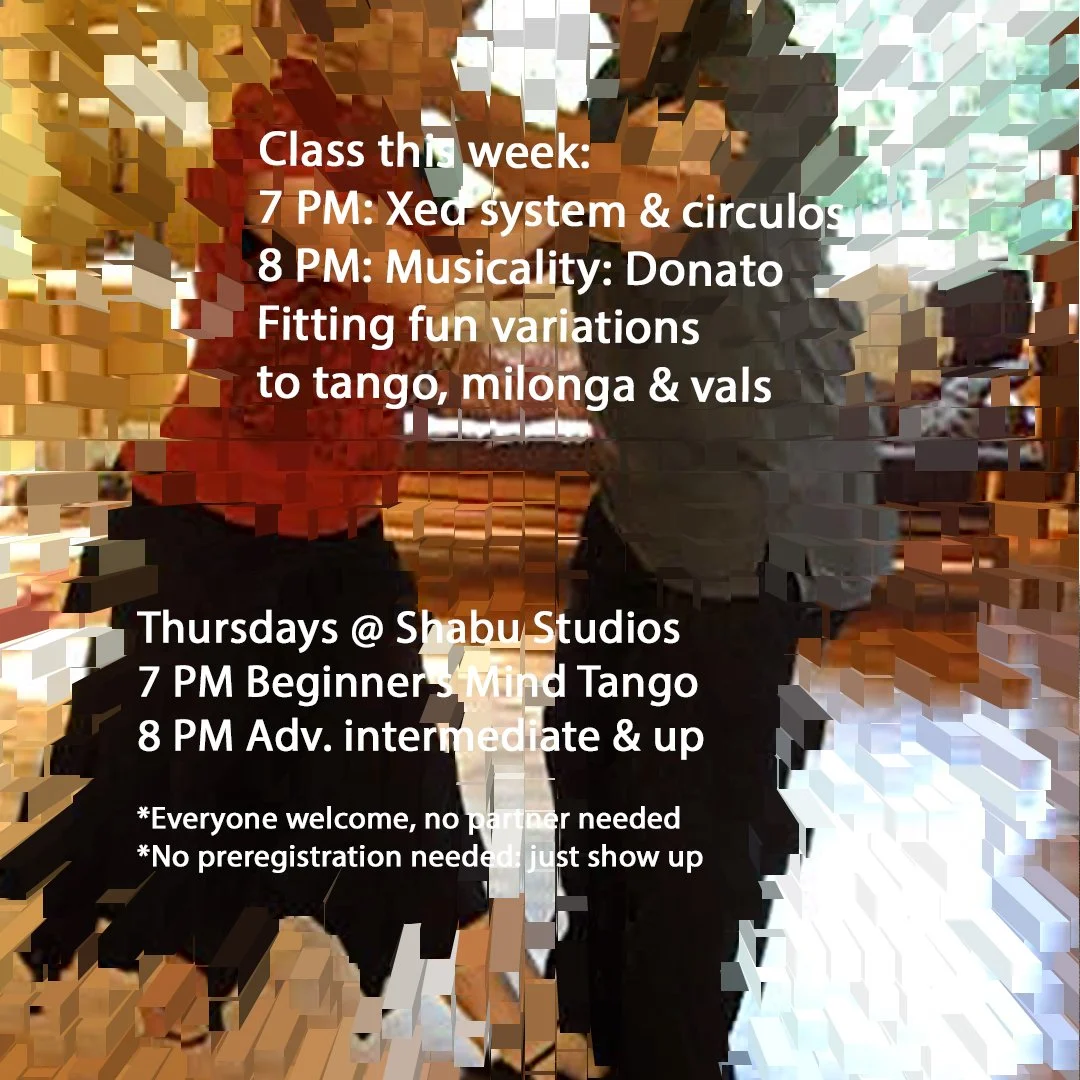
Class this week
Come join us to explore the music of Donato (tango, milonga, vals). We are playing with switching from crossed system to parallel system AND syncopation (corridas). Come dig in with us!
Expanding the musicality in your tango
To me, musicality is more important than steps in tango. I will happily dance with someone who has five moves, but uses them in varied ways, skillfully exploring tango music (and vals and milonga). I know that for some dancers, the feeling of confidence comes from knowing moves. For me, I prefer to have the moves serve the musicality rather than the other way around.
An orchestra a week
Do you want to expand your musicality? What can you do to move beyond moves, into dancing? This was my reason for introducing my Thursday class to one orchestra each week.
You might not be able to identify the orchestra, the song, or the decade but spending time listening to a song WHILE dancing in class gives you time to try out different ideas and figure out what might work for you when at a milonga. When on the dance floor, navigation, social needs, and other elements can crowd out learning about the music; so, trying this in a class or practica works well.
Does this song suggest that you move slowly instead of stepping on the beat for a while? Does it suggest long pauses or short pauses? Does it TELL you what to do, or whisper it to you?
But I like steps!
If your dance is ruled by steps, you can still approach the music your way. For example, can you walk to the cross in musically diverse ways, or do you always do the same thing? Can you pause at the cross? Can you move slow motion into the move? Try innovative ways to use each move and — voila! you have four or five possibilities instead of one!
This can be difficult with the moves that you learned as a baby tango dancer because you have danced them one way for years. My suggestion? As you learn a new move, immediately play with different ways to musically include it in the dance. Try fast! Try very slowly! Make it stretchy or brisk. Vary the size of the step and see what happens in the music.
Canaro this week
This week, we will explore Francisco Canaro’s music. There are tons of milongas and valses in his recordings, so we will do all three dances this week! Come try new things!
Festival tips for Valentango this weekend
Have you already planned what you are going to do this weekend at Valentango and are excited, rather than nervous? Great, you don’t need my help! Here are tips for beginning and intermediate dancers, especially those of you who don’t do the festival circuit and so do not have a large body of potential (already known to you) dance partners.
We will work on some other tips for a successful festival at my Thursday night class if you can come this week. Expect dancing in small spaces, adjusting for difficult embraces, getting YOUR dance whether or not your partner is skilled, and a few other tips.
Try the mixer milongas!
The mixers (6-8 PM) have a setup that allows EVERYONE to get into the game. The advantage is that you don’t have to cabeceo if you are unskilled or uncomfortable with the traditional way of inviting someone to dance. You will still get partners!
In addition, the tandas (sets) are usually shorter, with only two to three songs at a time. That gives you more opportunities in a brief time to dance with a variety of partners and find people you enjoy dancing with for future milongas.
There is a mixer each day. Careful: make sure that you look for the “mixer” rather than a milonga that “mixes” traditional and alternative music. Both are fun, but the mixer offers you more chances to dance if you are at a lower level of expertise.
Remember your manners
Festivals can bring out the worst in dancer behavior. Many people feel more anxious at a big social event like a festival, and social ability wavers. Unfortunately, that means that some people act more abruptly and may not remember to be gracious and polite. Try to model good behavior and most people will follow your lead.
Get enough sleep
You will dance better, have an enjoyable time, and be able to be kind to strangers if you get sleep during the weekend. You might miss an hour of dancing, but you will dance better and thus attract better partners. Plan a nap before dancing if you do not usually stay up until the wee hours of the morning, or you will enjoy the dancing less.
Get enough water and food
If festivals make you feel excited and/or tense, you may forget to eat and drink enough water. I remember a dance festival in my early twenties where I forgot to eat or drink anything all day. My good friends dragged me off the dance floor and made me eat and drink water. If that is also how you tend to be, pack a snack and a thermos!
Do one kind deed
Smile at someone EVEN IF you don’t want to dance! Not accepting a cabeceo is an entirely different part of the evening from passing someone in the hallway and being nice! A smile can make someone feel that they belong and that they are seen. Chat with someone and find out where they live, what they like about tango — anything positive. It will cheer you up too if you are having a hard evening.
Exploring tango music
One of the best compliments I ever received was, “You don’t just adorn with your feet, you adorn with your soul!” The other was, “Wow! You really know the music! I didn’t expect that!” When I asked if it was because I was a tourist or because I was a woman and following, he replied, “Both of those things.”
Part of my ability to dance IN the music is spending 30 years dancing tango, but there are faster ways to acquire that knowledge, and put it into your dance. In my group class, we explore an orchestra each week. Instead of what I normally see, where the teacher gives a short lecture on the orchestra, and instructs the students about what to hear, I prefer to provide time and space for each person to experience the music on their own.
Last week, we listened to and danced to di Sarli. For each song, we listened to part of the song, expressed opinions about what the music felt like to the dancers; and then we danced to the entire song. Sometimes, we repeated the song another time, with another partner. We did this with four or five songs. It’s true that there is more to an orchestra than a few songs, but it’s a good start to think and feel how a tanda of a certain orchestra inspires you.
This week, we are exploring Fresedo. I will pick a song or two that I like and then hit random so that we are not just listening to Elizabeth’s favorites. We play “What flavor is this song?” for each, choosing words (colors, flavors, feelings) that can describe the song the best for each person. After that, we dance it and look for any secondary “flavor” that is also there. After all, picking one thing and dancing for three minutes makes that go flat!
Self-study
There are myriad ways to learn tango music so that you dance better to it. The ONE thing that I don’t advise is: learning to step on the beat as your focus. That’s like learning the rhyming scheme of a poem and thinking that helps you understand what the poem is about. Yes, the beat is an important part of the music, but every dance class makes you practice that. Instead, let’s look at the emotion, the movement, the feelings of the music!
Start with what you like
As an English major, I made my teachers pull out their hair. “Write a paper about this poem and why you like it” was a nightmare assignment for me. I either felt that I liked a poem, or I didn’t, end of story. I listen to music in much the same way, despite years of piano, guitar and singing lessons.
Begin making a list of songs you like! Listen to them and add to the list as you find tangos that make you WANT to dance. I have no shame: I will walk up to the DJ and ask, “What is that song?!” and then write it down, find it in my collection, and listen to it until I know it well. When I find myself humming it while jogging, or wake up at 3 am singing it in my head, it is time to look for another :-)
Add in songs that you hear at the milonga
If you hear songs that you don’t like as well, take that as a challenge to still dance well to them. If you regularly listen to a certain DJ, you will find they play the same songs/types of songs. Pick from those to broaden your horizons. Often, as the song becomes familiar, you will find you like it more. Also, it makes more sense to learn songs that are played where you dance.
Recognize songs you don’t like
For me, there are well-known orchestras that just don’t speak to me. I can recognize that they are good, and point out how their music works, but they leave me cold. When I go to a milonga and hear the beginning of a tanda from one of those bands, I might initially sit out. I will avoid cabeceos if I can do so without giving offence. If someone begs, I will tell them I don’t really like the song, but I will dance if they really want to.
Even with these songs, I try to feel what the music is saying and respond to it as best as I can. We will be exploring these orchestras in class since I don’t want to prejudice another dancer against any song or orchestra if possible.
Listening and moving
For me, I listen better when moving around. For example, I can pay attention to a conversation better when spinning or knitting than sitting with my hands around my teacup. I need to move around while I feel what a song is about for myself. Do what what works for you personally. However, I suggest you move by yourself, because getting into the tango embrace makes many of us just revert to stepping on the beat :-)
Don’t worry if you are doing this “the right way” or not. Spend time with tango music playing around you, and approach it the best you can for you. And come to class and chat about it with other people who might hear something you didn’t, so that their dance enriches yours!
Set your tango goals for the year
This is NOT a New Year’s resolution! Why? Because, if you are like me, those only last until about February. Instead, I like to think of this as a focus for my tango for the year, a theme or topic to help me improve slowly throughout the year. This year, I have two goals: a personal/dance goal, and a community goal.
Personal dance goal
My goal for the year is to strengthen my core. I recently discovered that I have several muscles that were not contributing to my balance and core, probably from a difficult pregnancy and no PT afterwards. So, twenty years later, it’s time to integrate them back into my body.
What does this mean for my dance? I must rebuild my body map. I must adjust my axis and how I use my body, which is hard after so many years of feeling my body without those muscles. However, I am already starting to be aware of them after two weeks of work, and my sense of where my body is in space is already improving.
I am grateful to my excellent trainer, Blaine Brignell, for making me do things I don’t want to do! I am not a weight-lifting, workout kind of girl, and I would never do this without help. I am also grateful to my lovely husband, who wanders in and asks, “Are we working out now?” despite my answer being a groan each time :-)
Quantum entanglement/building community
My second focus for this year is to build our community. In ancient times, back when the community started in the 1990s, there were not enough dancers to splinter into subgroups. Gradually, the older and younger dancers divided; newer dancers received less of a welcome because most people thought, “Oh, they are someone else’s problem.”
Since lockdown, tango has struggled to attract new dancers. Many dancers from before did not return to dancing. According to my son and his friends, young people have chosen to stay home and play on their phones instead of going out to dance. Those of us who returned to tango need to take responsibility for the health of our community and recruit new dancers. So, my goal for the year is to invite my friends who don’t dance tango, to try it out; and to dance with more beginners.
Bring a friend to class!
One of my tango students invited me to West African dance class. After a 25-30-year break, I got back out there. In a sea of people, I struggled to see the teacher. In a class that was crazier than usual (the teacher’s 50th birthday), they covered three dances instead of the usual one dance. My body vaguely remembered tiny bits of the dance from a few decades ago, but . . . ack. I am deeply thankful that there were no mirrors!
I am so proud of myself that I made it through the class! I am proud of myself for knowing that I looked awful but doing it anyway. I am proud of myself for jumping in. I would never have made it to class without a personal invitation and prodding.
To build community, we need more dancers. In an age of sitting on the couch, scrolling through Instagram and TikTok, we ALL need help to get out there and try something new. What one friend do you have who you would love to see out on the dance floor? It’s a numbers game: ask ten friends and one will come. The more friends you have out there dancing, the more YOU will feel like dancing too!
Happy New Year! What is YOUR tango goal? I would love to hear about it!
Please share your goals!
Thankful for all of you!
I think I have the best job in the world! I get to teach people to dance. I get to help folks improve their balance, strength, flexibility, and find ways to continue mobility and independence as they age. I am lucky enough to teach enthusiastic teens who aim to teach tango later on as a sideline to other work. I love seeing adults indulge their curiosity in a new venture, even if learning feels scary. I enjoy preparing couples to brave their wedding dance as a team. I literally have students from fifteen to ninety between yoga and dance; I learn so much from each of you!
As I start my fortieth year of teaching dance; my thirtieth year of teaching tango; and my fourth year as a certified yoga instructor, I want to thank you for believing in me, supporting my work, and creating a community together.
Bring your tango technique to heel!
This week, I have been obsessed with dancing with less effort by grounding my axis into my heels. You already know that I disapprove of dancing with heels lifted off the ground: you lose energy in each step, and you can damage your feet more easily. However, how far back onto your heels should you balance?
Your heels are bigger than you think
Look at a diagram of the foot. Do you see how enormous your heel bone (calcaneus) is compared to your other foot bones? Look at the location of your ankle joint. Your ankle joint is above and IN FRONT of a large portion of your calcaneus. Think of the calcaneus as a kickstand behind your body, helping to balance you every time you land.
Use your heels instead of leaning
Most tango dancers are too far forward on their feet. I know: I just watched a video of myself leading in a performance, and I should have been better aligned! If we all lean, why should you care about technique and your foot structure? Why is standing on axis so important?
Leaning forward as a leader puts your head over your partner’s feet, which means that you will land on their feet. If you stand up and put your weight back into your calcaneus, you can move forward without the weight of your leg making you fall forward onto your partner and their feet.
Leaning forward as a follower often leads to sore toes, hurt arches and lower back pain. If you put your heels down—and stack yourself up from the center of the arch and metatarsals, you will have more ease in your dance. You will look more elegant because your body is more relaxed, and you will have fewer injuries.
Check out what I have to say on my YouTube video about this topic!
Pivoting
But, Elizabeth, how can I pivot with my heels on the floor? Don’t I have to tip forward to turn? NO. You will have to take weight off of your heels to pivot, but please keep them touching the floor. Instead of tipping forward, engage your pelvic floor and use the power of your inner thighs, pelvic floor, and deep abdominal muscles to elongate your body so that you can maintain your axis as much as possible while pivoting.
Remember: if your heels are already skimming the floor, you can put them down easily if you are falling over! Dancing with your heels up makes you vulnerable to other dancers knocking you over and hurting you!
Exercises to improve your technique
Piece of paper
Grab a piece of paper, or a small towel, or anything thin that you can put on the floor. Put your standing leg heel on it. Then practice pivoting and taking the object with you. You don’t want to turn around your heel: the heel should slide on the floor as you pivot, taking the paper/towel with you.
At first this IS difficult. Your brain will want to pop up on your toes. Then it will try to do heel pivots. Be kind to yourself and patient. Eventually, you will feel your heels skim the floor but not impede your pivoting.
Yoga block or exercise ball
Hug a yoga block, an light exercise ball, or a pillow between your upper thighs, and practice pivoting while you turn on your adductors, pelvic floor, and deep abdominal muscles. You will notice that you can turn around your axis more smoothly. You will also start to feel how that muscle activation allows you to keep your heels against the floor while pivoting.
Dancing tango keeps your brain young!
According to the journal Nature, researchers found that doing something creative helped to slow brain aging—and dancing Argentine tango worked better at this than playing music, making art or playing video games! You can read the article here.
On top of that, the more adept the tango dancer is, the younger the brain compared to the expected age. The study notes that the experts at tango had brains that averaged seven years younger than their chronological age! We now all have a good reason to:
continue (or start) dancing tango!
improve our tango level!
Let’s do it! You can get the citation for the original article, as well as further interesting articles on aging and the brain at the website I linked above.
See you in class tonight!
Slow down to feel your tango!
North American culture values being busy and looking busy. I remember I often heard “you are lazy” as a child, and most of you would say that I am NOT a lazy person. To get ahead, we must work! Work harder! Try harder! At sixty, I am finally able to just sit on my front porch for five minutes without doing something else. We miss important moments by rushing around being Yankees.
Argentine Tango is not North American. One Argentine told me, “You poor Puritans! So uptight! We do what we want and go to confession!” Life is busy in Buenos Aires, but I notice a different approach to time spent with other people. Coffee with a friend lasted three hours more than once in my experience. Going out to dinner means you can linger over dessert, wine or coffee until you hunt down the waiter; not until they hand you the bill and murmur, “No hurry!” while eyeing the door. One day I took a “walk” with a friend that ended up being six miles of wandering through the city. Time is savored, not wasted, or rushed.
Of course, not everyone in any culture is same, and there’s much variation, both here and in other parts of the world. Can we take a page out of that book to savor more of our tango?
Breathing
Breathing is the beginning of everything. If you are unaware of your breath, you may be moving too fast to tune into your dance. Find your breath and explore how your movement is tied to your breathing patterns. Your diaphragm is part of the line of deep core muscles and connective tissue down the center of your body. Breathe and the dance works. Hold your breath and you lose your body. Remember, slow down until you can find your breath, and you will find your dance.
Fall in love with your feet!
Tune into your body. It’s a fabulous puzzle of bones, muscle, and connective tissue. Enjoy the sensuality of BEING in your body! Breathe. Feel how you dance from place to place. Experience your feet holding you up, adjusting to each movement, communicating with your partner. And if your feet are that incredible, what about the entire body functioning smoothly, allowing you to dance? Slow down and revel in how you can move.
Let the music run the show
Slow down! Each tango has a beat. However, there is much more inside of the song: double-time, half-time, pauses, slow motion — that is not “the beat” alone. You lose opportunities to let the music express itself through you if you just learn to step on the beat. Let it move you. Tune in! Try out dancing around and off the beat, then back on it.
Slow everything down
When you slow down, what else do you hear? Let yourself feel how you move in space with your body; how you interact with your partner; how you connect with the entire room of dancers; how all of you dance with the music. As you relax into this approach, the dancers around you will unconsciously respond to your pauses, stillness and flow, and they will also start to move better.
Gratitude: Shannon Butler!
I dropped by the milonga last night for a bit at Shabu Studios. I was super tired, so sorry if you saw me and I wandered off instead of chatting! However, I was not so tired that I failed to notice what a lovely job Shannon has done to make Tuesday evening milongas in Portland a great place to gather and dance. It was an outdoors in the parking lot evening (with a good portable floor); there was food; there was danceable music and a cool evening with the sun setting, but what made the event was Shannon’s friendly hosting and how that has built a friendly, happy group of dancers. Shannon introduced the new-to-Portland dancer, who was immediately grabbed for a tanda. Next time you see Shannon, remember to thank her for the (often thankless) task of hosting community events! It’s a lot of work for very little pay, but we would not have a dance community with organizers.
Celebrate what you can do and set your intentions!
You will hear about what I am studying for my chair yoga certification for at least six more weeks as I try to wrap up my program. I constantly find information that I know I had heard in my first yoga teacher training—but that I didn’t really “hear” until now. A lot of it can inform tango practice as well as yoga.
Celebrate what you can do
Every week, students come to me and say, “Oh, I saw x dancing, and s/he can do SO much more than I can!” I know that it is difficult to not constantly compare yourself to the dancers around you. I am prone to the same behaviors. However, this does not help build your dance; it limits you.
I am grateful that my broken toe has healed, and I can once again run. I can’t run as fast as I did twenty years ago. I can’t run as far as I did twenty years ago. I can still run, however, and I am once again getting faster. Every time someone blows past me, I remind myself that I can still run and that it’s not a competition.
I know I am not the best tango performer. I have intense stage fright. I don’t enjoy performing. Instead, I can celebrate that I have managed to perform and do a good job despite that debility. I celebrate that I can choreograph and can help other dancers who do enjoy performing, to prepare and dance on stage. I rejoice that my work includes helping dancers find themselves in their dance, and reap enjoyment, exercise, self-expression, and social connections from dancing.
Set your intentions
Celebrating where you are does not mean you must give up or stop trying to improve your dance. It means that you have the chance to set your intentions, learn about yourself and your body, practice diligently—and you will achieve those goals. It may take time. You may end up adjusting your goals. What matters is that you find a path for yourself, with intentions that slowly build to your goals.
Millimeter by millimeter
Set smaller goals and allow yourself the luxury of reaching your goals! Can you feel how you are using your “good” foot in every step of the dance? Great! Now, tune into how your “other” is catching on as the “good” foot gets better (remember we are trying to be positive, not mean to ourselves). Can you do ONE beautiful pivot? Yes? What about two? OK! What about three? It really is that slow a process; enjoy the journey instead of railing against it. I am not good at process myself, so I know how hard this can be.
Slow down!
The body takes time to learn movement pathways. We need to slow down and let it catch up: we understand the idea intellectually faster than we can do the movement: slow down! Take the time you need, however much time that is. When the movement pathway is carved into your body memory, you will immediately be able to do it better and faster. Trying to speed up when the body is not ready just slows the process down.
My current intention
After dancing at John Filcich’s 101st birthday party two weeks ago, I have a new intention, or a renewed intention. I need to take better care of my body if I plan to lead the dance on my 101st birthday, with great posture and style. Turning sixty kicked me into gear about exercising. Having a friend drop dead suddenly at sixty last month, sent me to the doctor’s office to get a checkup. Dancing at a 101st birthday party made me start working on how and what I eat. Remember that taking care of yourself, eating correctly, getting enough sleep, taking time to relax — all contribute to your improvements in tango. After all, don’t we all say, “Here’s a dance I can do until I die!” Well, let’s focus on that being a LOOONG time from now! I have a free hour, so I am going to go practice walking and pivoting. How about you?
Ahimsa for tango
I have begun my chair yoga certification training. Most of the information has been a review from my 200-hr. yoga certification course. However, there have been a few pearls of wisdom that I “heard” better this time.
Ahimsa
One appropriate concept for tango is ahimsa, or non-violence/non-harming. Yes, we all know about being nice to other dancers, diplomatic about feedback, and avoiding injuring others. However, what about yourself?
Non-violence includes not harming yourself:
Instead of pushing your body to the point of injury, maintain a middle level of effort: challenge yourself instead of injuring yourself. Choose variations of moves that allow you to protect your body while moving towards harder techniques.
Focus on positive speech towards yourself. Banish “my stupid foot” and “my bad boleo” and instead, think of how well your body serves you, and praise yourself for what you can do competently!
Sankalpa
The idea of sankalpa, is to set a mental intention, and then to follow through with that intention. Sometimes it is difficult to stick to an intention, so here are several ideas to help:
Set up a gradual set of steps in the intention, so that you develop a path towards change. The path is not a straight line, but gradually, you will achieve your goal.
Put the goal in writing. Envision success. You may not get there, but if you do NOT envision that goal, that success, you will never get there.
Each time you dance, remind yourself of that intention. For me, I remind myself that my goal is to have fun :-)
Non-violence and clear mental intentions: in the total chaos of what’s happening around us, we need to stick to taking care of ourselves and each other, to envision our goals clearly, and to move towards achieving positive gain.
Daily practice pays off
Learning a new skill
I am learning Japanese. I am improving by tiny increments. Because I have a strange schedule as a dance and yoga teacher, I cannot take any of the classes offered locally by different colleges. Because I am a kinesthetic learner, I learn best by writing to remember characters, words, and phrases. I am an “in-one-ear-out-the-other” learner if I try to learn by hearing and repeating.
I can read and write the two syllabaries (hiragana and katakana) slowly now. If I practice every day, I can choose the correct characters 100% of the time on a quiz. If I don’t practice every day, I forget several. If I don’t practice for a week, I forget a lot.
Every day, I try to write all of my hiragana and katakana characters. I pay attention to stroke order. I practice the differences between the ones that look almost identical. I never thought I would spend time on YouTube, patiently following along, writing characters! I am still intimidated by kanji (who needs three writing systems? Aaaah!!!!).
Little by little, I am learning to say polite greetings, to count, tell the time, say what day of the month or month of the year it is, relate how old people are, and count money. In other words, I am worse than a three- or four- year-old at Japanese. However, I am having fun, and I have the goal of talking to a three- or four-year-old in Japan—our Japanese exchange student now has a child, and we want to visit. As we are going to visit someone who does not know English, I have a very strong wish to master basic Japanese.
Learning tango
If you are learning tango, you can apply these same ideas to your learning. Give yourself a “carrot” or goal: next year in Buenos Aires!
Learn your best way
First, find out what kind of learner you are. If you learn movement by doing movement, you have the easiest job. If you learn by watching, make sure you are watching SOCIAL tango and not just stage dancers on YouTube! If you learn analytically, figuring out what angle you need to place your feet or twist your body helps you to tackle tango; have a PT or chiropractor evaluate your alignment and help you devise exercises for your weaknesses. If you are an audio learner (my absolute weakness personally), dancing listening to instructions—or getting to know the music first—may be your best bet.
Practice every day
However you learn, you need to apply those skills at least several times a week to your dance. You do not have to block out huge amounts of time to do this. Even practicing for the duration of one tango tune daily will help you improve.
Practice alone
Yes, I know that is not fun, but you need to work on your own body technique (balance, contrabody, alignment) more than you think. People always tell me they cannot practice without a partner, but most of my practice is solo. That is how I improved the most. During COVID lockdown, our Zoom classes replace in person. I was skeptical at first, but I saw advances in technique that paid off after lockdown.
Practice with people
The best reason to attend a group class is to make yourself practice! Private lessons work much better for learning deep technique. Group class is for practicing with various people (and to have a good time/social time). Practicas are also helpful, although dancers report to me that so many people are “helping” them by giving feedback, that they feel too dispirited to try to go to milongas. If you attend practicas, choose how much feedback you can handle and from whom, to make that time valuable for your dance.
DANCE!
All work and no play makes Jack a dull boy. Go to milongas, even as a complete beginner. You will be able to see how people dance in your community, you will start to meet more advanced dancers, and you will become part of the community. Go before you get intimidated: just jump in! My favorite learning tool for language (and for tango) is to jump into the culture and get along as best as I can.
The big carrot: Anti-Alzheimers approach to life
Learning new skills takes patience and can be very frustrating, so to continue, we need to keep worthy goals in mind. Remind yourself that when you learn, you make new connections in your brain. As we age, we lose connections, so it is doubly important to continue to learn throughout life. Tango is especially good against Alzheimers and other forms of dementia if you focus on recombining patterns, playing with variations, and varying your practicing. The improvisatory nature of Argentine tango creates more connections than learning rote dances.
I hope we are all out there still dancing at 95!